
Key findings
New York has the third highest concentrations of millionaires in the US and has added millionaires far faster than non-millionaires over the last decade
Business advocates claim that New York’s millionaire population is growing too slowly due to the state’s progressive tax system, but states with the greatest millionaire concentrations tend to have progressive tax systems.
Advocates concerned about “millionaire share” often mistake a state’s broad-based population growth for its attractiveness to millionaires
Billionaires often raise the prospect of moving to Texas or Florida to admonish against progressive tax increases. These are inapt points of comparison for New York:
- Texas has added to its gross count of millionaires in keeping with its brisk population growth, but its high-earners are tied to place-based industries rather than geographically competitive ones.
- Florida has increased its millionaire concentration, but its economic model is not replicable.
Progressive taxation and extensive public investment are the most replicable and sound strategies for states looking to achieve economic prosperity.
Introduction
New York faces acute fiscal needs in the year ahead. New York City’s looming budget gap, deep federal cuts to Medicaid and SNAP, and the profound unaffordability of housing and childcare all threaten the quality of life for New Yorkers across the socio-economic distribution.
New York City Mayor Zohran Mamdani and legislative leaders in the New York State Senate and Assembly have proposed funding these needs with progressive tax increases. In response, business advocacy groups have pointed to New York’s declining share of the nation’s millionaires, the “millionaire share,” as evidence that the state cannot afford any further progressive taxation.
But are progressive taxes causing millionaires to decamp to Florida and Texas? This brief will discuss the millionaire share and show that states’ concentrations of millionaires are not only uncorrelated with their tax systems, but that the most prosperous states tend to have progressive tax systems. It is worth noting that there is no debate as to whether progressive taxation raises revenue. FPI has documented that millionaires are not more likely to leave New York in response to higher taxes. That being the case, increases to top income tax rates unambiguously generate substantial revenue.
Those concerned over the “millionaire share” presume that New York would be home to more millionaires if its tax system was more regressive. Even if this were true, a regressive taxation would definitionally generate substantially less revenue from millionaires (and everyone else—Texas and Florida have no income taxes). As such, the concern over the “millionaire share” seems to be driven by a belief that maximizing the number of millionaires in New York is a desirable policy goal in its own right. This brief explores this view and finds both that increasing the millionaire share is not, in and of itself, a coherent policy objective, and that progressive taxation is the most evidence-based strategy to attract and retain millionaires.
What is a “millionaire”?
The debate about millionaires in New York turns on a possible misapprehension about the meaning of “millionaire.” Tabloid media tends to focus on anecdotes about the wealthiest individuals in America. In policy discussions about where millionaires live—including this paper—“millionaire” exclusively refers to those with “tax filings reporting at least $1 million in annual adjusted gross income.” A couple with a collective salary of $500,000 who earn $500,000 when they sell their house is, at least for that year, a “millionaire.”
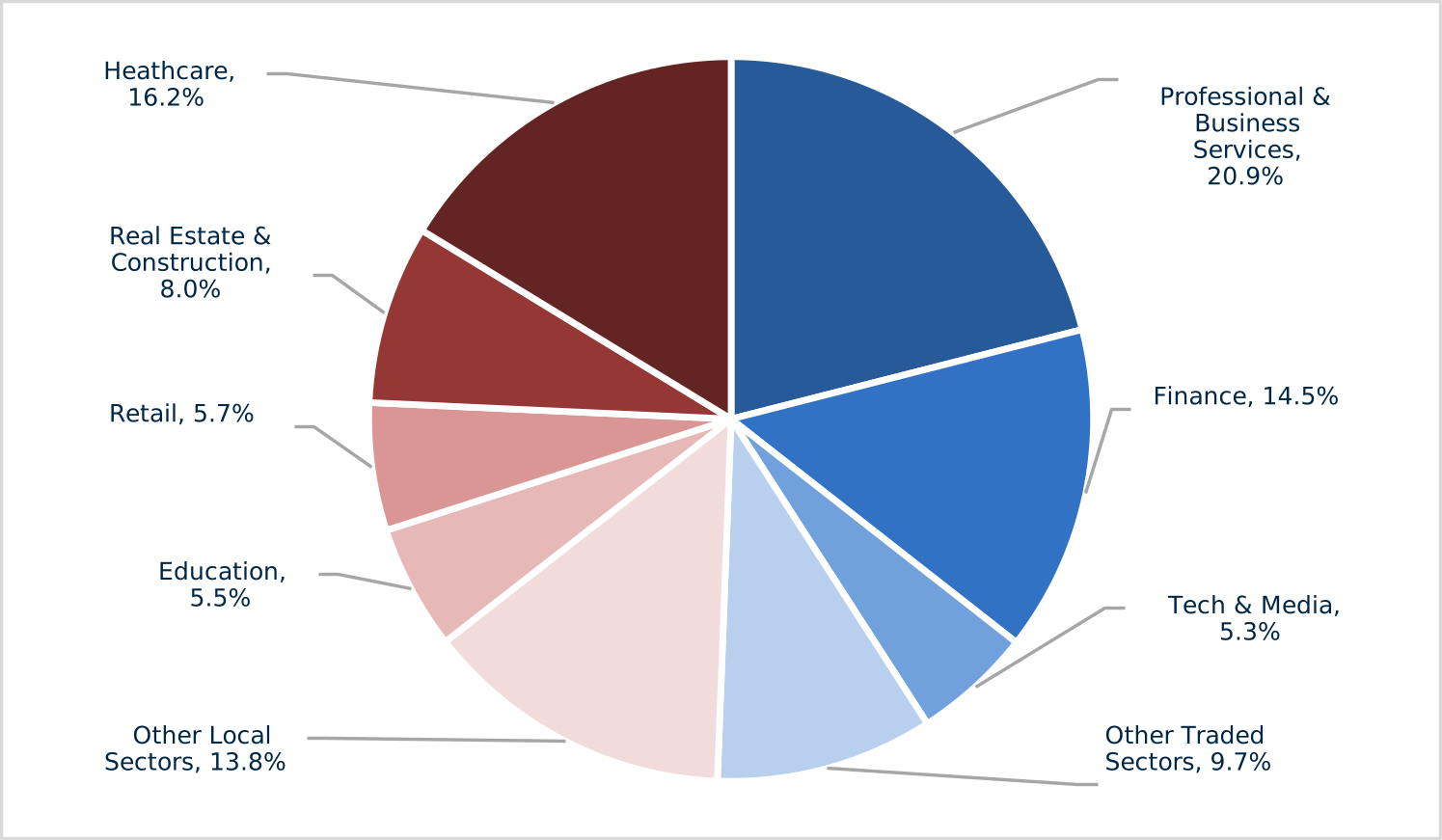
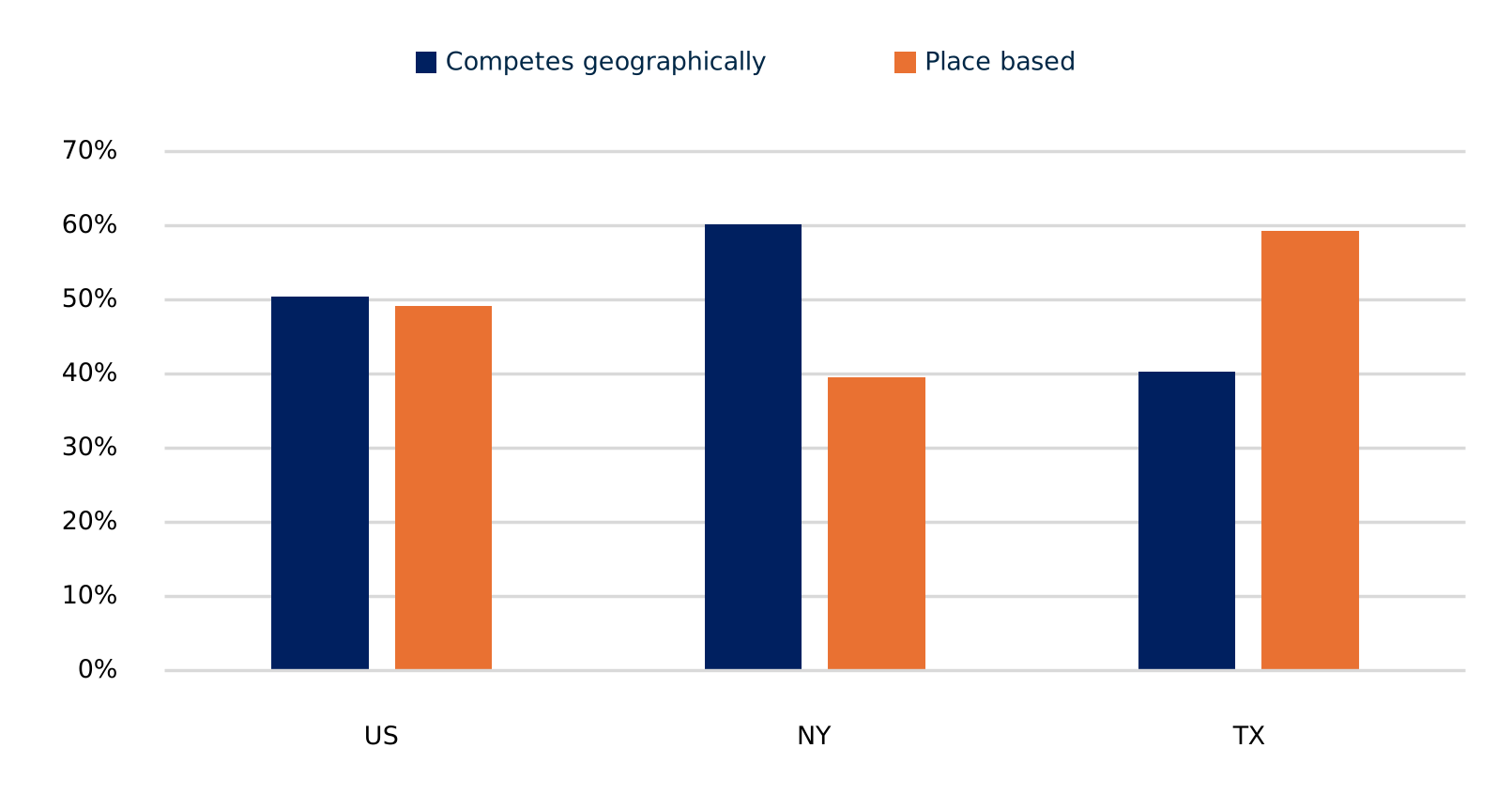
Because of this, the US’s eight hundred thousand millionaire tax filers are more broadly distributed across the economy than one might expect, as can be seen in figure 1. One in six millionaires (16 percent) work in healthcare. About half (49 percent) of millionaires work in industries that, like healthcare, are place-dependent and do not compete across geographies. As a result, the growth of millionaire tax filers is strongly tied to population growth. When a briskly growing city opens a new hospital, it will create new millionaires. This is unrelated to the mobile financiers of the popular imagination, packing their bags and moving across the country as marginal tax rates rise and fall.
Fig. 1. Workers in millionaire households by industry
Red sectors are place dependent, while blue sectors compete across geographies
What is the “millionaire share”?
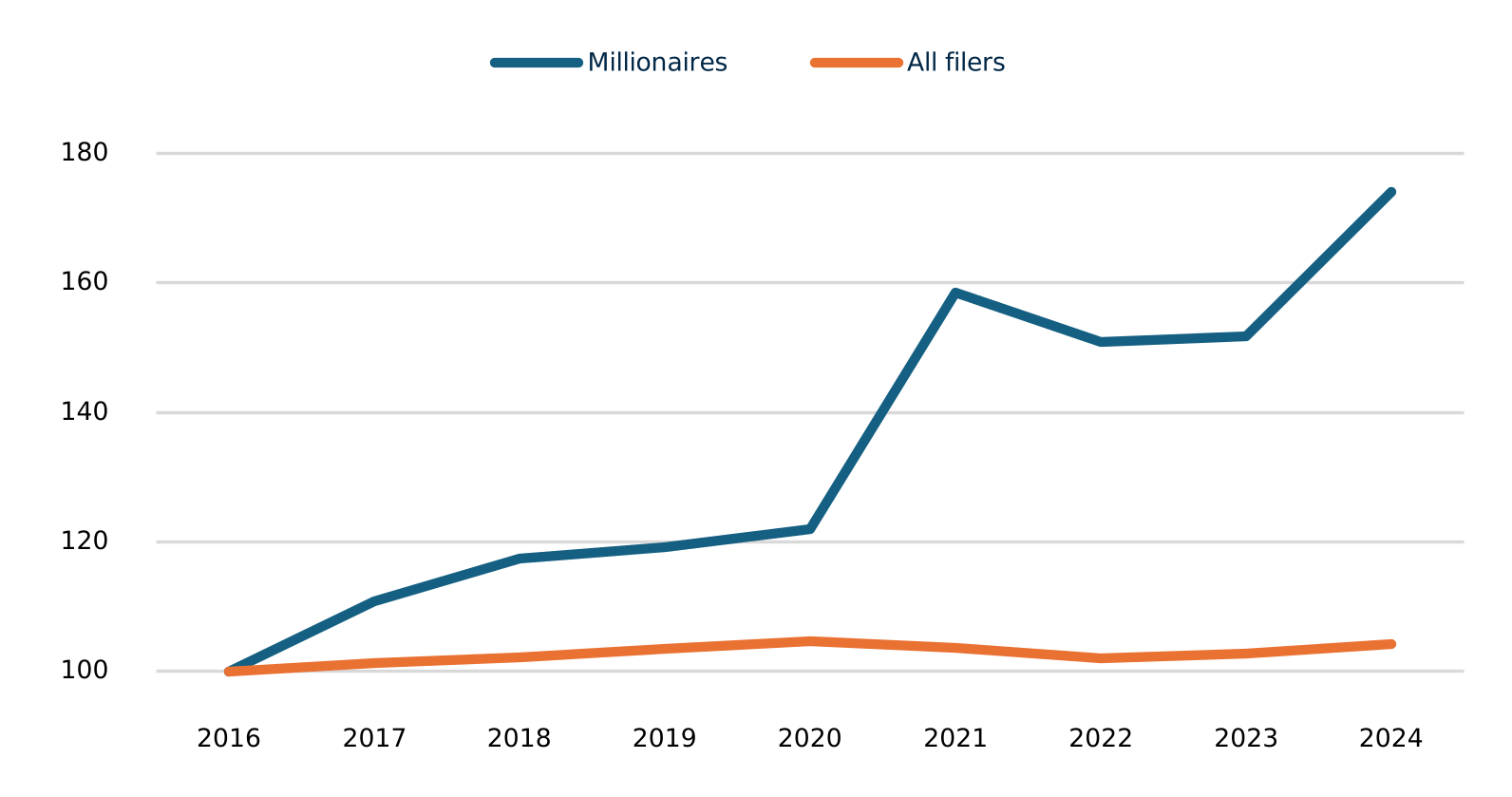
New York is a rich state: its personal income per capita and number of millionaires per capita are both the third-highest in the US (the former behind Massachusetts and Washington, the latter behind Connecticut and Massachusetts).1 The state’s population of millionaires grew 74 percent to a record high of 99,400 between 2016 and 2024 (the longest time range available from the highest-quality data obtainable from the New York State Department of Taxation and Finance →). Over the same period, the total number of New York tax filers rose by just 4 percent → (see figure 2). This rate of growth is too low for some business advocacy groups, who note the number of millionaires grew even more briskly in states such as California and Florida, lowering New York’s share of national millionaires. This is taken as circumstantial evidence of an unfriendly business environment → in New York.
Fig. 2. Growth in total and millionaire tax filers in New York State, 2016 to 2024 [indexed to 100]
Does the “millionaire share” mean anything?
Is there a truly connection between a state’s share of the nation’s millionaires and its policy stance? An analysis of states’ millionaire populations does not reveal any connections to state policy environments. The states with the most millionaires per capita are rich, Northeastern states that apply progressive income taxes to millionaires. Connecticut, Massachusetts, and New York have the most millionaires per state resident. Each also has a progressive tax system with above-average rates on millionaire earners. While Florida and Texas are famous counterexamples, they are exceptions to a general positive correlation between millionaire tax rates and millionaire resident concentrations (see figure 3).2
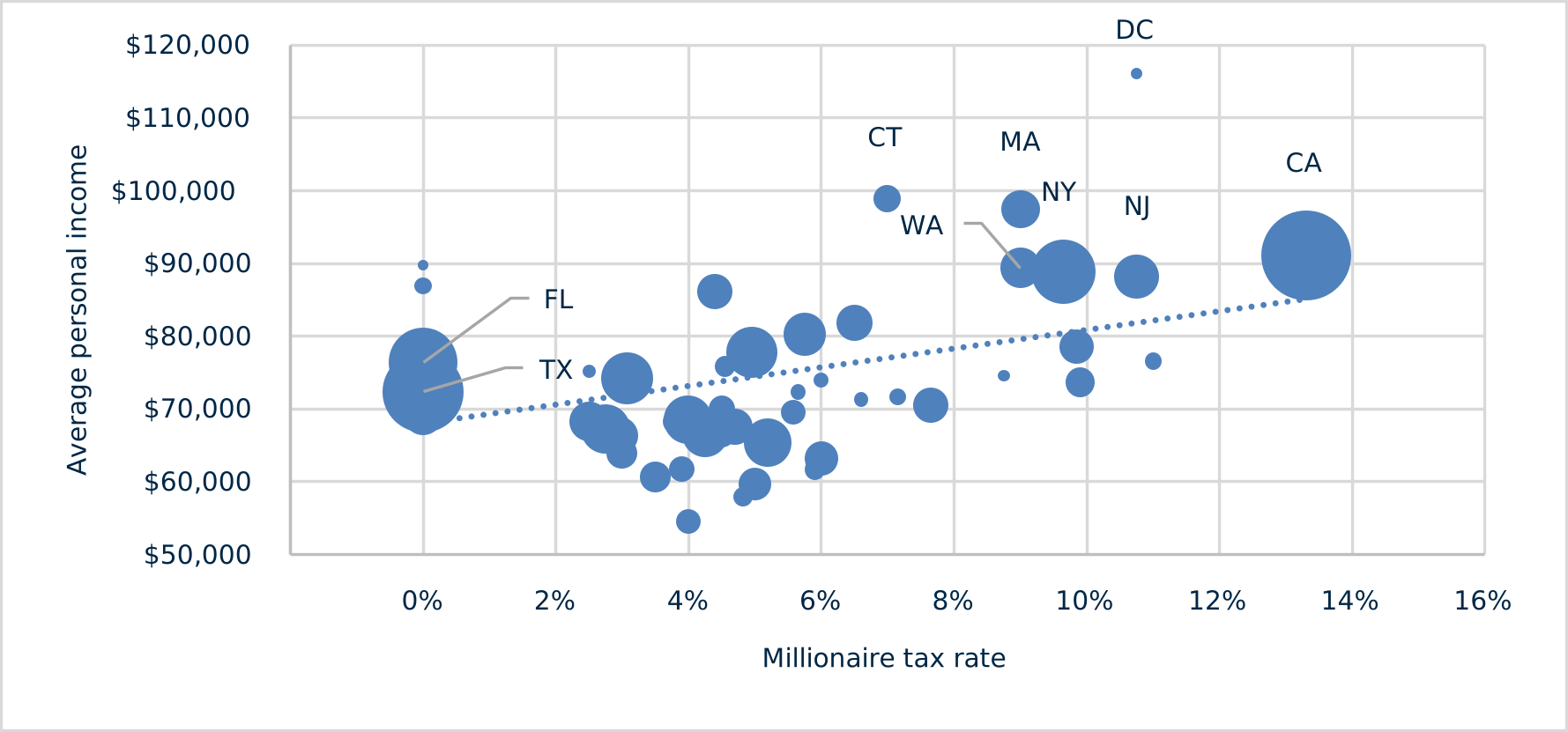
A state’s millionaire population is closely related to the broader prosperity of the state’s economy. High concentrations of productive industries tend to create higher average incomes and more millionaires. In the US, these high-productivity industry agglomerations—and high average wages—tend to be in states with more progressive tax systems (see figure 4).
Fig. 3. Millionaires per 100,000 residents and millionaire income tax rates
Size of bubble indicates size of total population
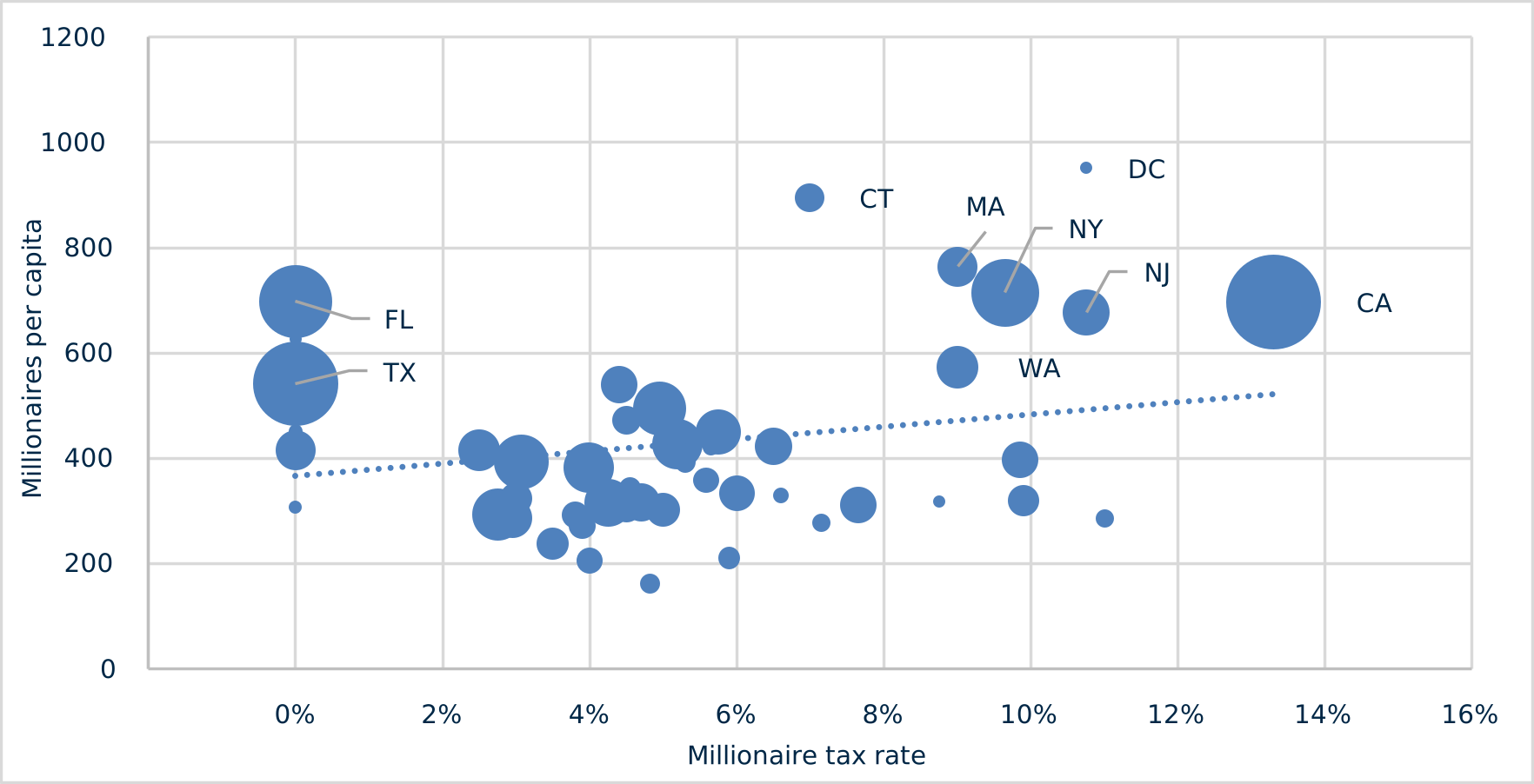
Fig. 4. Average personal income and millionaire income tax rates
Size of bubble indicates size of total population
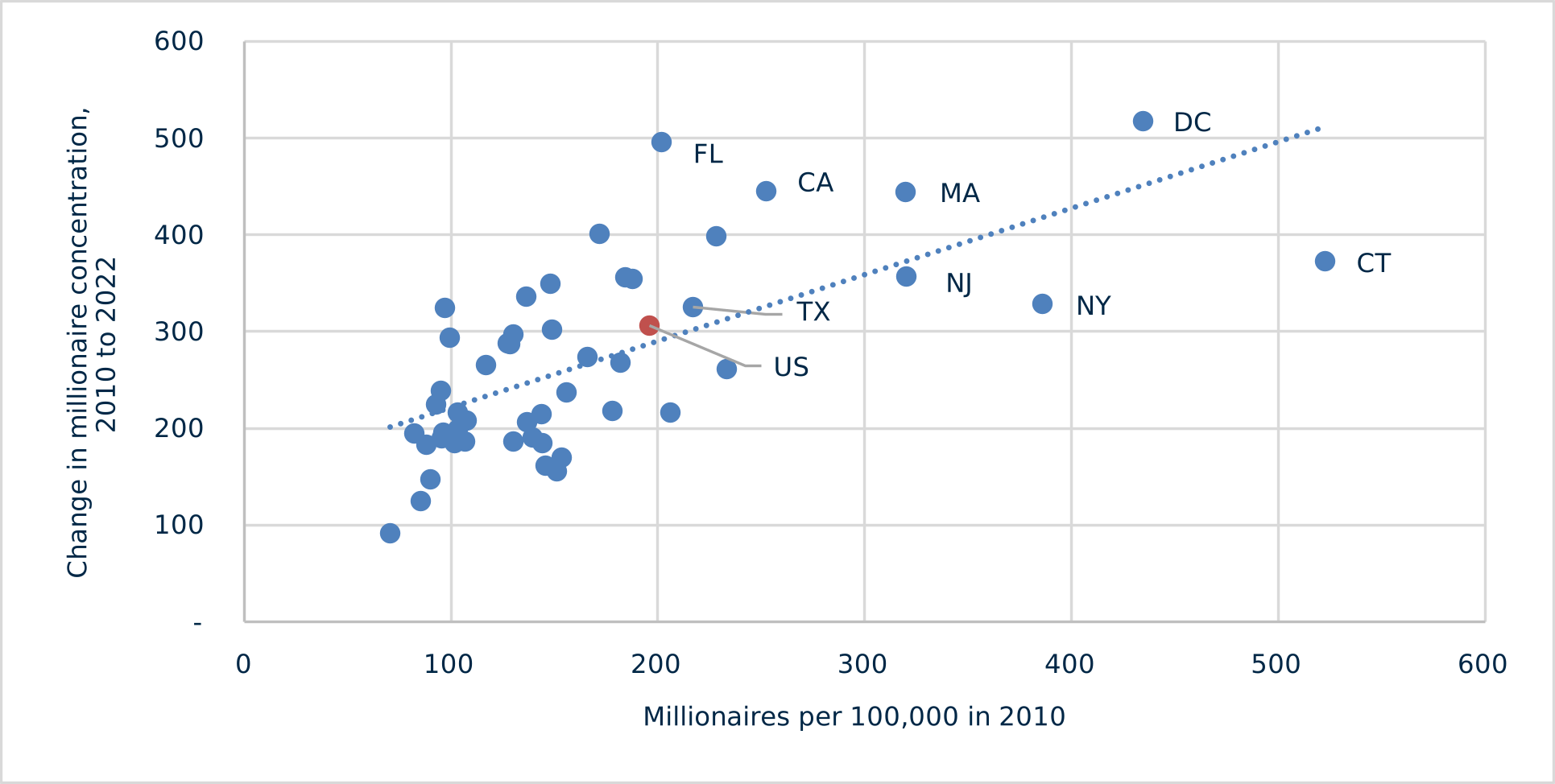
Advocates concerned about the “millionaire share” worry not just about concentrations of millionaires, but about the relative growth rates of millionaire populations. Here, correlation with state tax policy is murkier. From 2010 to 2022, all states saw their concentrations of millionaires per capita grow. While growth in Florida was especially strong, so was that of California and Massachusetts. Growth of Texas’s millionaire concentration was the weakest among large states and close to the national average (see table 1).
At a national level, no correlation exists between millionaire concentration growth and top tax rates. Rather, state millionaire concentrations are strongly path dependent—states with the most millionaires in 2010 added the most millionaires per capita over the following decade (see figure 5).
Table 1. Changes in millionaire concentrations in select states, 2010 to 2022
| Millionaires per 100,000 | |||||
|---|---|---|---|---|---|
| State | 2010 | 2022 | Change | % change | Millionaire tax rate |
| Connecticut | 523 | 895 | 372 | 71% | 6.99% |
| Massachusetts | 320 | 764 | 445 | 139% | 9.00% |
| New York | 386 | 714 | 328 | 85% | 9.65% |
| Florida | 202 | 698 | 496 | 246% | 0.00% |
| California | 252 | 697 | 445 | 176% | 13.30% |
| New Jersey | 320 | 677 | 357 | 111% | 10.75% |
| Texas | 217 | 542 | 325 | 150% | 0.00% |
| US | 196 | 502 | 306 | 156% | —% |
Fig. 5. Change in millionaires per 100,000 residents between 2010 and 2022
What lessons does this teach us?
States with progressive tax systems are more millionaire friendly
The data unambiguously disproves the idea that progressive taxation drives away millionaires: Insofar as a correlation between the millionaire populations and tax policy does exist, states with more progressive tax systems tend to have higher concentrations of millionaires. Nor is it the case that states with regressive tax systems have especially fast growth in millionaire concentrations: while Florida has, so have California and Massachusetts.
Rather, the trends highlight the primacy of states’ existing economic structures. Dense agglomerations of high-wage industries (e.g., finance, tech, and professional) in Connecticut, Massachusetts, and New York, have historically produced high concentrations of millionaires and continue to drive growth of millionaire concentrations that outpace the rest of the nation. California has had particularly robust growth on the back of its decades-long tech boom.
While this does not prove that progressive taxation causes economic prosperity, a large body of urban economic literature sheds light on factors that foster productive economic clusters. Density of skilled workers and existing, specialized firms are drivers of growth →. Recent research shows that the extensive provision of public goods and services is necessary to support this level density. Coordinating public infrastructure at the scale necessary for dense cities requires strong state capacity →. That New York City is home to the nation’s broadest and most diverse labor market is possible only because of its extensive public transit system and dense housing.
General population growth creates millionaires
This paper analyzes the relative concentration of millionaires within each state’s population. This measure best captures state economies’ propensities to create and retain millionaires. Those concerned with the “millionaire share” often look at gross counts of millionaires. This measure largely reflects population growth—states that add total residents quickly also tend to add millionaires quickly. As discussed above, general population growth itself creates millionaires in place-based sectors such as healthcare.
“Millionaire share” analyses home in on two large, fast-growing states with regressive tax systems: Florida and Texas. Of the two, Florida experienced robust growth in its millionaire concentration, indicating millionaire growth beyond what would be expected given its general population growth. Texas did not. Rather, its millionaire population grew in proportion to its broader, brisk population growth. Texas’s millionaire population is more place-based than New York’s: the former’s top-earners are concentrated in industries such as healthcare and real estate, while the latter’s high-earners are more loaded into globally competitive industries such as finance (see figure 6).
That Texas is not producing or attracting an outsized share of millionaires relative to its general population does not invalidate that state’s growth model. Texas’s fast growing housing supply has produced growth that largely maintains middle-class affordability. Affordability and broad-based growth represent coherent policy goals, unlike the race to maximize the number of millionaires in a state. The lessons to be learned from Texas derive from its appeal to the working class, not millionaires.
Fig. 6. Millionaire population by type of industry
Only one economic model is replicable
So, what should a state do if it was nevertheless intent on growing its concentration of millionaires? It might look in two directions. In one corner, a cluster of states have progressive tax systems that enable them to invest in high-quality public services; and this public realm hosts highly educated populations and dense, deeply rooted agglomerations of high-income economic sectors. In the other corner stands Florida, the historic magnet for affluent retirees. Emulating this state would be difficult, as it would mean abolishing state income taxes—a seismic shock for most states, which would necessitate leaning on the more regressive sales and property tax bases. It might also require developing two seaside coasts and sprouting some palm trees.