Key findings
More than one million New York households (over three million people) simultaneously receive SNAP and Medicaid. Nearly one in three of these dual-recipient households includes a child under the age of fourteen.
846,792 adults in dual-recipient households will be subject to work requirements for both SNAP and Medicaid, and thus liable to lose both benefits.
- Of these, 141,000 will lose SNAP and 135,000 will lose Medicaid due to failure to meet work requirement mandates.
Among all dual SNAP–Medicaid households, 52,840 people in 33,806 households are newly exposed to SNAP work requirements and simultaneously in the ACA Medicaid expansion band—meaning they will face Medicaid work requirements for the first time as well.
- 98 percent of these individuals are currently not meeting Medicaid work requirements.
Approximately 41,000 legally present immigrants in New York will lose SNAP and Medicaid benefits under new OBBBA restrictions on eligibility.
Introduction
Approximately one million households in New York State, encompassing over three million people, simultaneously receive both Supplemental Nutrition Assistance Program (SNAP) benefits and Medicaid coverage. This group includes nearly the entire SNAP recipient population. These dual-recipient households sit at the intersection of the two largest federal safety-net programs. They are also among the most economically vulnerable households in New York: definitionally low-income, disproportionately composed of people of color, and deeply dependent on both programs to meet their basic food and healthcare needs.
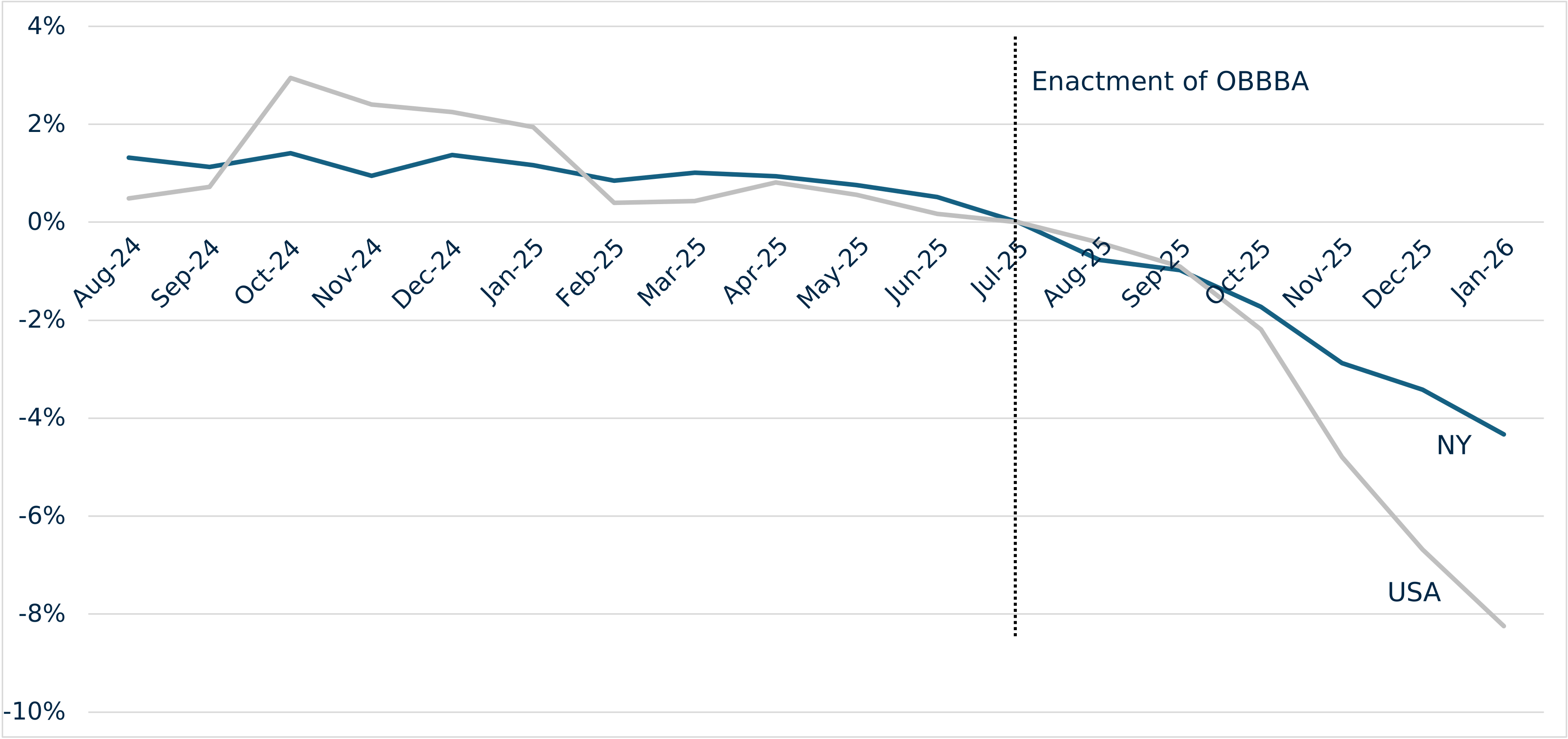
The One Big Beautiful Bill Act (OBBBA →), signed into law in July 2025, made sweeping changes to both programs and eliminated eligibility for some immigrant groups, including refugees, asylum seekers, and those who have been victims of sex trafficking.
For SNAP, the OBBBA expands an already-existing set of work requirements for Able-Bodied Adults Without Dependents (ABAWDs)—raising the age ceiling from fifty-four to sixty-four and narrowing the childcare exemption to children under fourteen. These work requirement changes went into effect → on March 1, 2026.
For Medicaid, the OBBBA imposes work requirements on the Affordable Care Act Medicaid expansion population—the first time work requirements have ever been introduced as part of the program. The OBBBA also tightens documentation demands →, increases recertification frequency, and reduces retroactive eligibility. Further, the act makes changes to the Essential Plan that take effect as early as July 2026. Changes in work requirement rules for Medicaid recipients begin January 1, 2027. Precise guidelines for the implementation of the Medicaid work rules will not be final until the fall of 2026.
For households relying on both programs, the risks of benefit loss are compounded. Loss of SNAP worsens nutrition and health →, increasing demand on Medicaid, which will be harder to access under the new rules. Loss of Medicaid limits a person’s ability to work, increasing the risk → of losing SNAP. For children in these households, adverse consequences extend into lifelong development →, lowered educational attainment, and reduced earnings. For the state, the costs of inaction today—in uncompensated care, greater use of hospital emergency services, downstream public health burdens, and reduced future tax revenue—could far exceed any federal savings realized through benefit reductions.
This report measures the number of Medicaid and SNAP recipients that are at risk of losing both benefits. It distinguishes between risk types, as many individuals will likely lose access to each program due to both the additional restrictions on enrollees and the added administrative burdens imposed. A second report in this series will discuss policy solutions to ensure that vulnerable New Yorkers maintain these essential services.
Fig. 1. SNAP enrollment compared to July 2025 [OBBBA enactment]