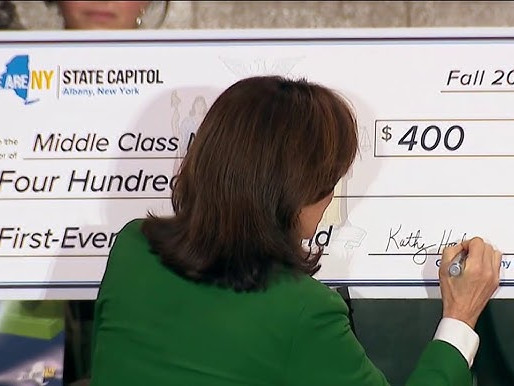
Each year, New York lawmakers herald the state budget by announcing a new, billion-dollar commitment to making life more affordable for working people. Unfortunately, these measures often consist of one-off tax rebates and other payments that are spread so thin as to be immaterial to the cost-of-living issues pressing down on most New Yorkers. They do, however, cost considerable sums of money, usually $1–2 billion. If these funds were instead deployed as part of a deliberate, permanent program, they could contribute meaningfully to making New York affordable.
The fiscal year 2027 budget is set to continue this tradition by issuing $1 billion worth of rebate checks, ostensibly meant to offset energy costs. While details of the checks are not yet clear, they appear to be modeled on an Assembly proposal that itself mirrored last year’s “inflation refunds,” which sent $150 to $400 checks to most New Yorkers for a total cost of $2 billion.
Billion-dollar one-off gimmicks have been a feature of every budget since fiscal year 2023. The trend has become so pronounced that it is now clearly a recurring feature of the New York State budget. Some of these one-offs have commendable aims, such as supporting care workers’ wages, while others—including the inflation refund checks from last year—amount to stunts that do not meaningfully affect New York State’s affordability.
Nevertheless, even well-meaning one-off payments are inferior to well-targeted, recurring expansions of public services in areas such as childcare, healthcare, and housing, which would truly bend the cost of living downward over the long run. For instance, three core prongs of universal childcare—doubling New York’s Paid Family Leave policy, expanding universal care for three-year-olds statewide, and instituting living wages for childcare workers—would each cost about $1 billion.1 These ambitious, permanent steps toward universal childcare are in direct competition with annual one-off payments. Similarly, the energy rebates are likely to cost more than double the $400 million necessary to maintain healthcare for the 450,000 New Yorkers losing coverage because of federal cuts enacted last year.
Note: This table includes debt service prepayments. While not tax refunds, the heavy use of debt service prepayments in recent years is a major component of the State’s recycling of surpluses into one-off uses
New York Policymakers’ increasing preference for one-offs is the result of two budget-making practices—deflating revenue expectations and using the Transactions Risk Reserve (TRR). With one hand, the Governor’s Division of the Budget (DOB) projects that revenue will grow at unreasonably low rates. With the other, the State moves $2 billion from the general fund into a reserve fund, ostensibly to protect against economic downturns—in reality, the money is always returned to the general fund at the end of the fiscal year, contributing to substantial surpluses.2 The Governor has ramped up use of both tactics in recent years, artificially depressing apparent resources available for future budgets.
For the past four years this has played out as follows: Real revenue exceeds expectations, TRR funds are recognized by the budget, and the State ends the fiscal year with considerable surplus; at the same time, anticipated future revenue is dampened by pessimistic projections and continued diversion into the TRR. Together, these practices create a perpetual illusion that short-run surpluses will be followed by future hardship.
New York’s economy is strong and can support meaningful, long-term investment in programs that raise the standard of living for all state residents. But when fiscal abundance appears to be temporary, policymakers prefer to make short-sighted policy interventions instead. This misapprehension is the result of the State’s fiscal choices, which obscure the reality that more State funds are available every year than are acknowledged by the State Division of the Budget. This revenue would be better spent on deliberate, permanent programs, such as universal childcare, continued healthcare for low- and moderate-income households, and social housing, which would set New York on a true path to greater affordability.