Albany, NY | Fiscal Policy Institute Acting Executive Director and Chief Economist Emily Eisner released the following statement on behalf of FPI:
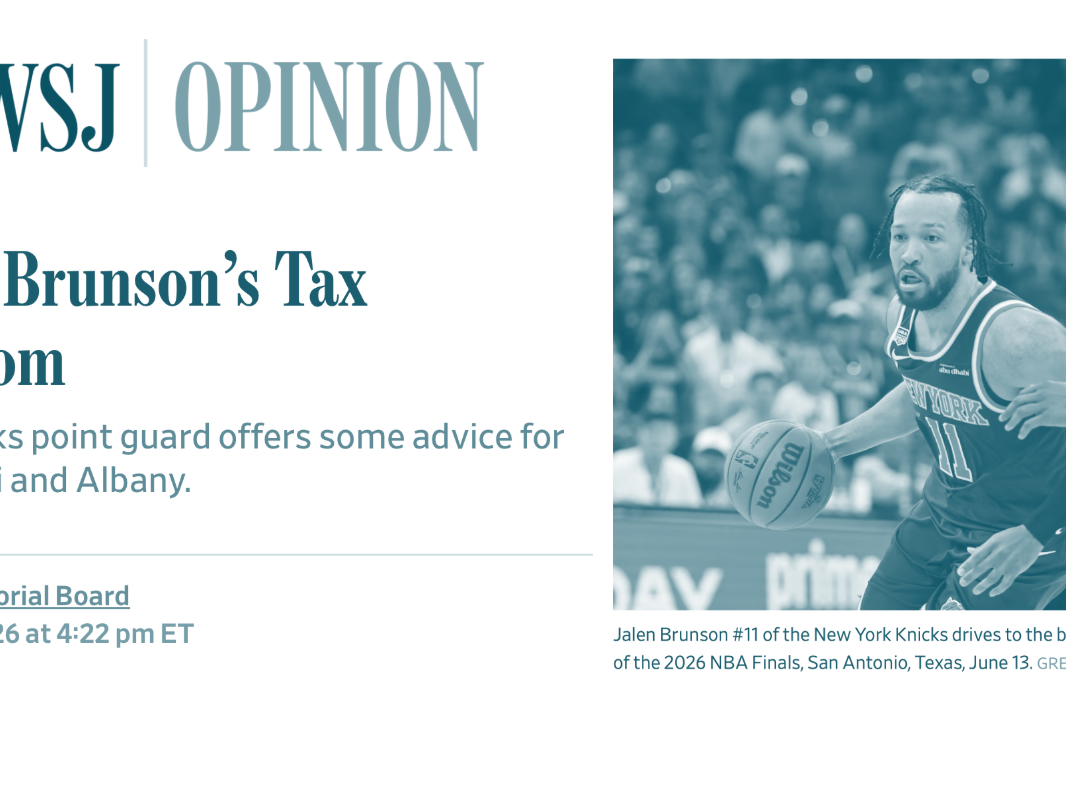
The Wall Street Journal’s editorial board recently seized upon a postgame remark → by Knicks point guard Jalen Brunson, the “King of New York →”—who noted that he “miss[ed] the Texas taxes” he paid while playing for the Dallas Mavericks—interpreting it as a repudiation of the statewide movement to raise taxes on the rich. The Journal warned that an increased high-earner income tax could lead the Knicks to “have a harder time finding free agents.”
This a selective reading of both the evidence and Mr. Brunson’s own actions, which speak far louder than his offhand comment. Mr. Brunson has demonstrated a clear revealed preference for New York’s economic and cultural ecosystem, choosing to relocate to the nation’s largest metropolitan area despite its progressive tax system.
As with many ambitious high earners, in selecting New York he has prioritized the high quality of the peers and colleagues that could propel his team to a championship, reflecting the power of agglomeration economies.
Mr. Brunson’s trajectory is consistent with FPI’s extensive research on high-earner migration: The top 1% of income earners are the least likely ↓ to leave New York State, as they have the greatest ability to afford its high cost of living. Outmigration is concentrated among lower-income households forced to leave due to unmanageable housing costs—not progressive taxation.
Far from indicating that the rich are overtaxed, Mr. Brunson’s choices reinforce the case for a more progressive tax structure. Ambitious revenue measures can be readily tolerated by high earners and will enable many more New Yorkers to enjoy the state’s unique economic, social, and cultural resources—not the least of which are its exuberant sports fandoms.
The Fiscal Policy Institute is an independent, nonpartisan think tank that advances sound and equitable fiscal policy to strengthen New York’s economy through research, analysis and strategic communications.