New York City’s Fiscal Challenge
March 5, 2026 |
Key Findings
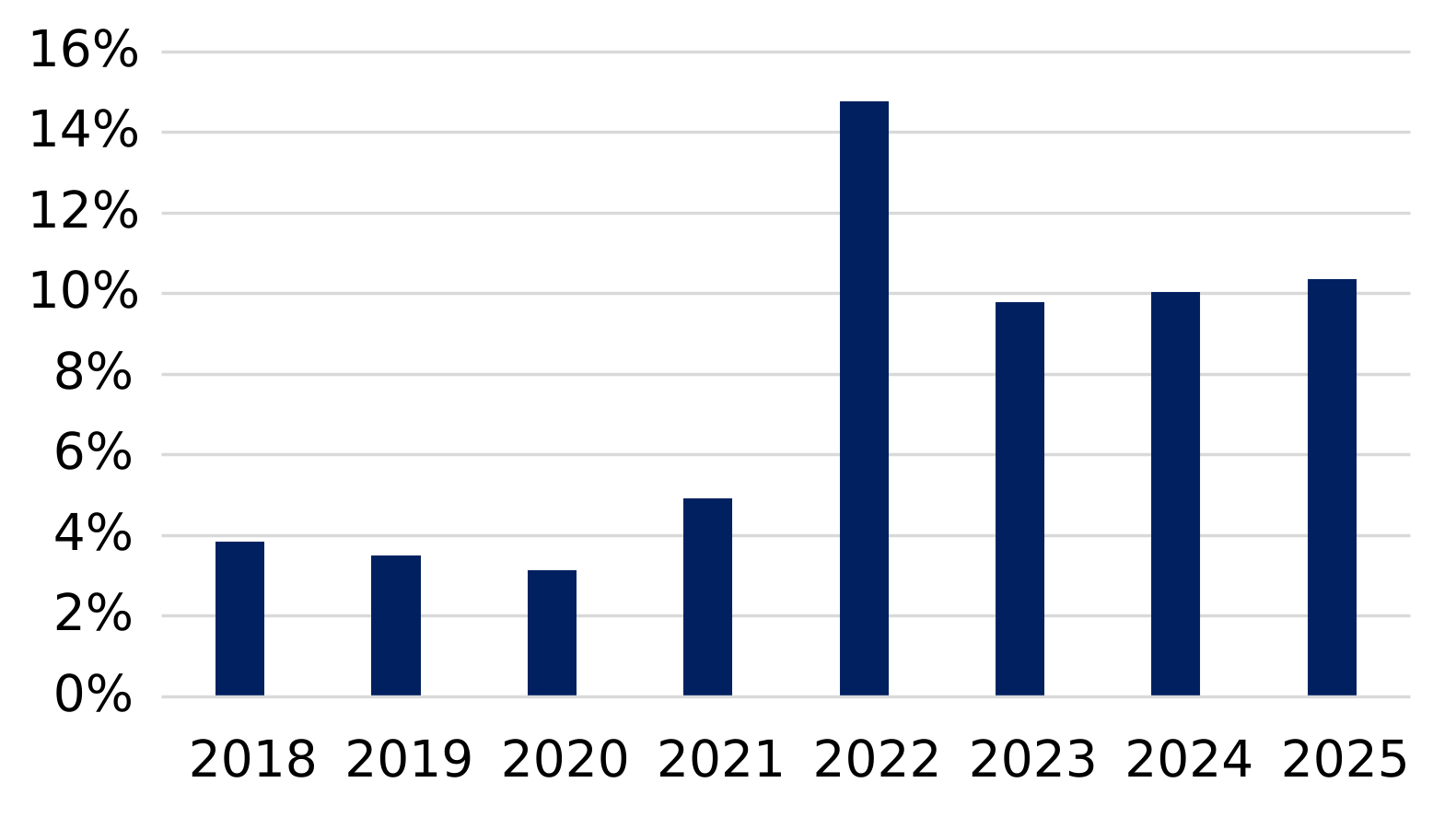
- Mayor Mamdani’s allegations of prior fiscal mismanagement are substantiated by data showing a significant increase in underbudgeting of spending during the Adams administration. Actual spending exceeding planned by an average of 10 percent.
- New York City’s fiscal capacity is constrained by its lack of control over its own tax system: City revenue has fallen relative to the size of its economy in recent years. This contrasts with the State, which has maintained revenue growth proportional to its economy by increasing tax rates on top earners.
Recommendations
- Authorize New York City to generate $5.5 billion in revenue by raising its own personal income and corporate taxes.
- Restore recently cut or eliminated state funding for New York City, totaling $1.5 billion in revenue lost each year.
Introduction
On February 17, 2026, New York City Mayor Zohran Mamdani presented a preliminary budget that revealed deep imbalances in the City budget. These shortfalls, created by persistent mismanagement during the prior administration, imperil the City’s fiscal footing. To address these imbalances, the City must either seek greater fiscal contribution from top earners and corporations or choose from among inferior options that include spending cuts.
The State has played a central role in creating this problem. The New York State Constitution forbids New York City from controlling its own tax system, handing that power to the state legislature. This has forced the City into a fiscal straitjacket in which revenue fails to keep pace with economic growth and spending needs. New York State has also eliminated and reduced some of its funding to the City, compounding the situation. New York City’s fiscal duress can be solved by easing both conditions: the State should restore the funding it recently cut from New York City and allow the City to raise additional revenue.
Fiscal mismanagement under the prior administration
In the lead-up to the February 2026 preliminary budget, Mayor Mamdani argued to the public that he inherited a budget that had been chronically mismanaged by the previous administration. Analysis of the City’s recent budgets provides strong support for this claim.
Through its entire duration (2022–2025), the Adams administration engaged in dramatic, consistent underbudgeting—the practice of excluding certain spending from planned future budgets. This depresses apparent future spending, even though that spending is required by law. As the City makes its legally required expenditures, actual spending greatly exceeds initial projections. Underbudgeting was readily apparent at the time and commented on by numerous fiscal observers including FPI. Prior to the Adams administration, actual spending tended to exceed projections made in the prior year’s preliminary budget by about 3 percent. During the Adams administration, underbudgeting averaged 10 percent.
Figure 1. Actual spending relative to spending projected by the prior January Preliminary Budget
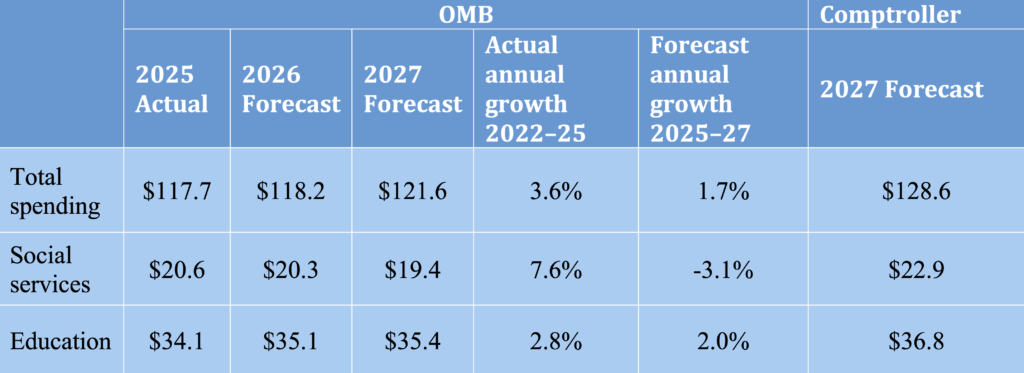
The Adams administration’s underbudgeting was concentrated in social services and education. In both areas, legally mandated program expansions required spending increases that OMB failed to properly account for in its spending projections. Social services underbudgeting was driven by three programs: CityFHEPS housing vouchers, public assistance, and shelter costs. Education underbudgeting was driven by two: the class size mandate imposed by State law and private tuition reimbursements for students with special needs (“Carter cases”).
Table 1. Actual and forecast spending on social services and education
New York City’s fiscal straitjacket
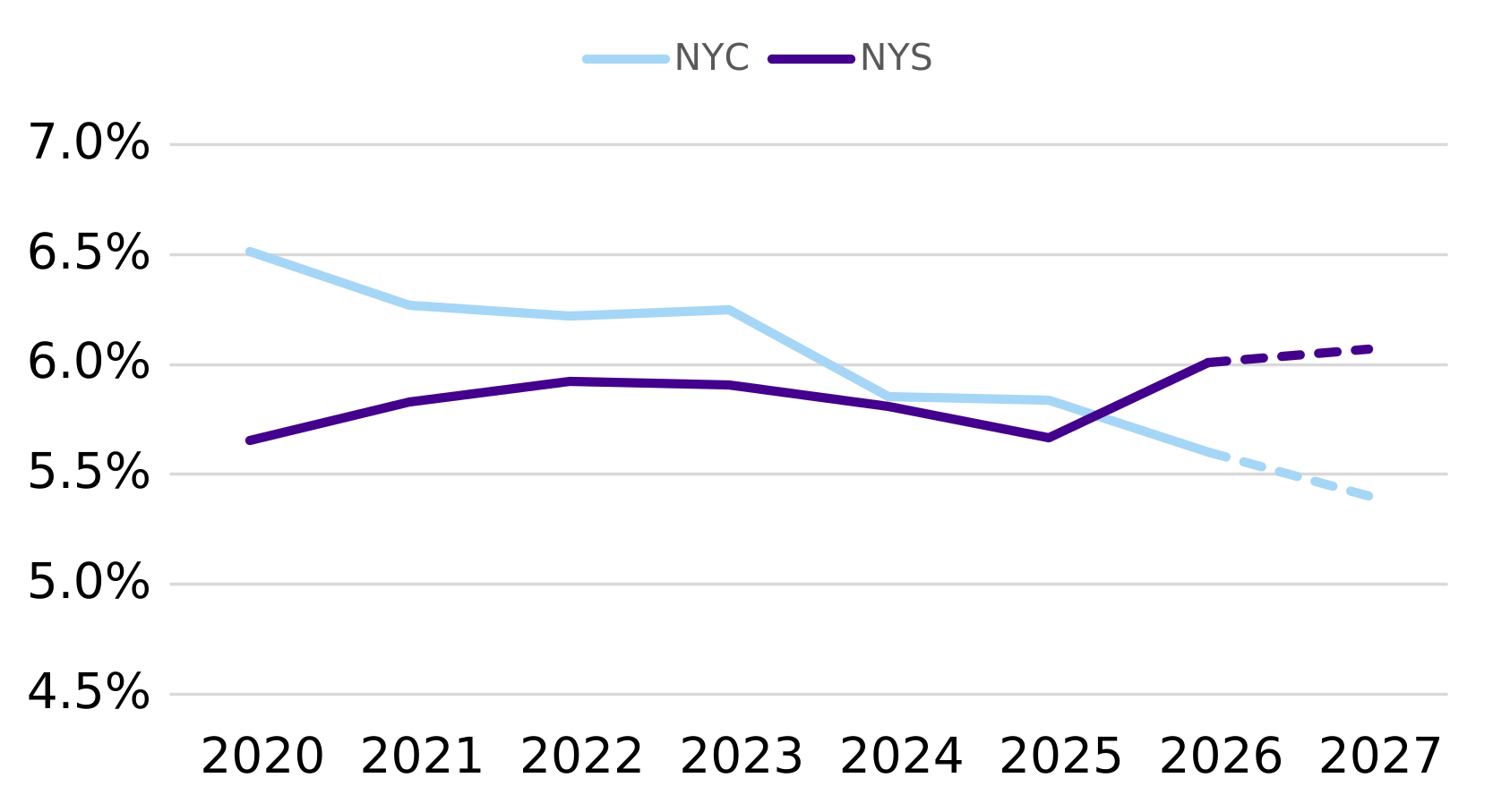
New York City spending commitments are outpacing its revenue. This is not because the City’s economy has stalled. Rather, its tax system has failed to keep pace with economic growth. Since FY 2020, the City’s own-source revenue fell from 6.5 percent of New York City’s GDP to a projected 5.4 percent in FY 2027.
By contrast, New York State’s own-source revenue has kept pace with the state economy since FY 2020 because the State raised tax rates on top earners and corporations. Regrettably, State law prohibits the City from adjusting its own tax system. Tax systems that fail to adjust to economic changes over time often erode relative to their economic base.
Figure 2. Own source revenue as a share of GDP for New York City and State, FY 2020 to 2027
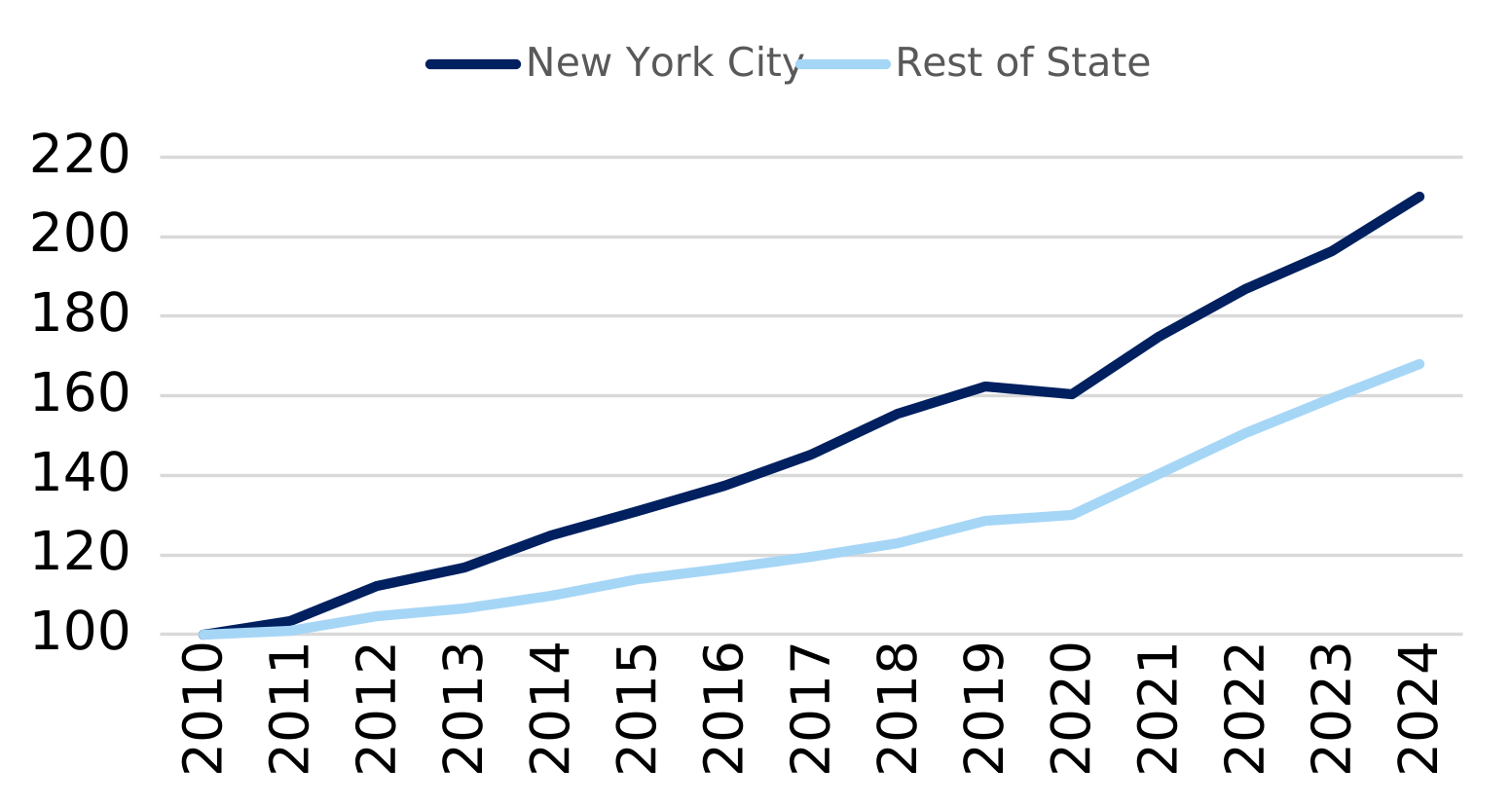
At time same time, New York City has been the engine of economic growth for the entire state. Between 2010 and 2024, the City’s economy more than doubled, rising 110 percent. By contrast, the rest of the state’s economy rose 68 percent over the same period. Despite this strong economic growth, the City’s tax system constrained its revenue.
Figure 3. New York City and Rest of State GDP growth, indexed to 2010
What about the “budget dance”?
Historically, the City has projected future budget gaps only for those gaps to disappear when revenue exceeds conservative projections. Further, fiscal years for which deficits are projected frequently end in surplus. This stage of negotiation has become known as the “budget dance,” in which Mayors deploy mirage-like deficits that ultimately turn into their opposite. Mayors use this tactic to gain an upper hand over the City Council in budget negotiations, reining in their spending demands. Is that what is happening here? A review of the two key pieces of the budget dance—pessimistic revenue projections and in-year reserves—suggests that it is not; the City’s current fiscal challenges are more real than those of the past.
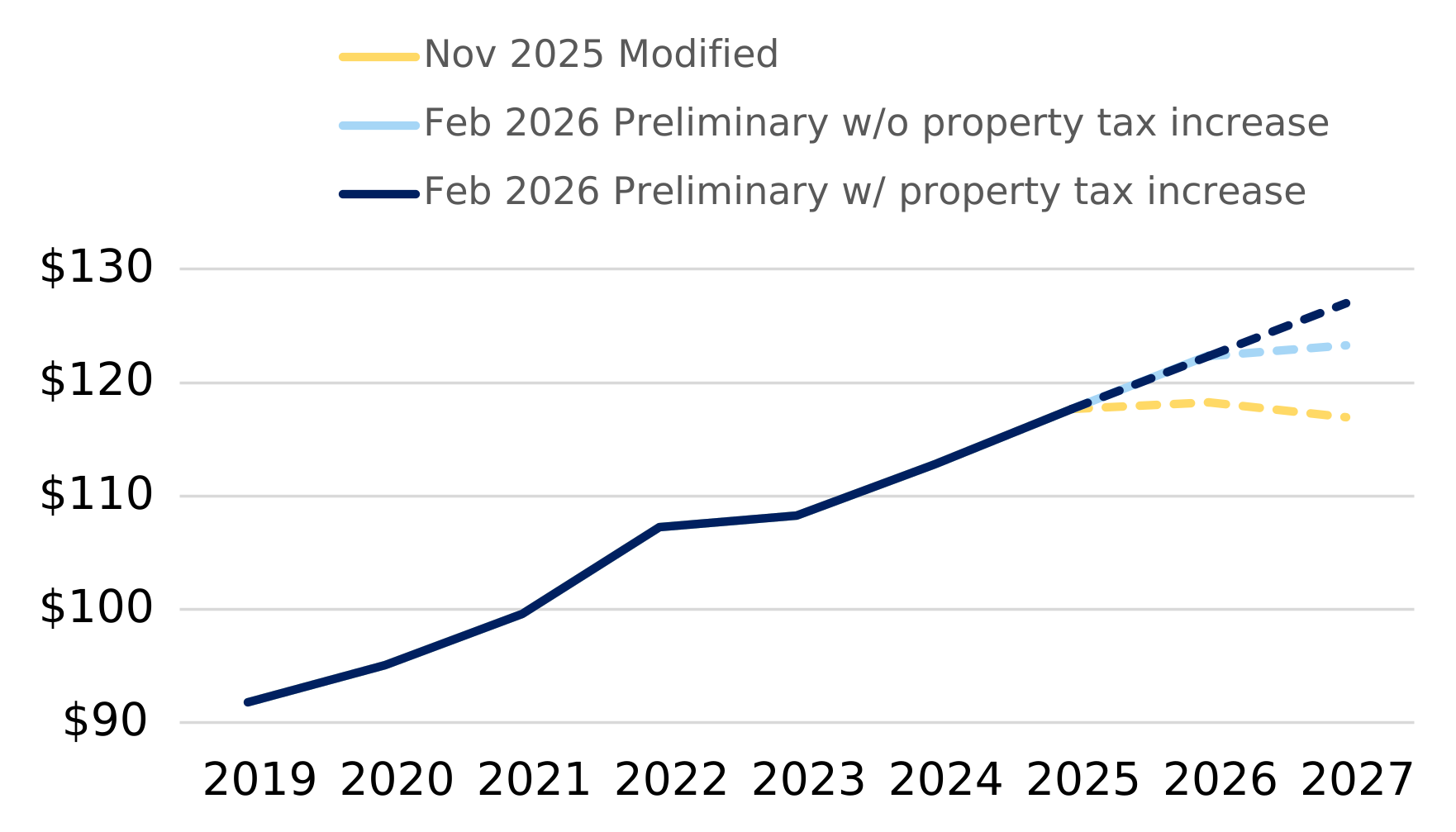
First, apparent gaps are usually driven by pessimistic revenue projections, which do not appear to be in effect in the City’s recent budget plans. This pessimism was clearly present as recently as the November 2025 modified budget. Mayor Mamdani’s February 2026 preliminary budget, however, made upward revisions to the revenue forecast that make the most recent forecast more realistic. The November budget plan projected negative nominal growth (-0.6 percent) for the two-year period of FY 2025 through 2027—a rate so low that it would be consistent with a major recession. The February budget plan revised revenue up, anticipating 4.0 percent growth in FY 2026. Further, the February plan expects FY 2027 revenue to be depressed (up just 0.8 percent) because of decreased federal funding; it also expects City tax revenue to grow 4.1 percent.1This expected 4.1 percent increase in City tax revenue does not include the property tax rate increase proposed by the Mayor in the event that the State does not agree to his proposal: “raising taxes on the wealthiest and corporations, and ending the drain by fixing the imbalance between what the City provides the State and what [NYC receives] in return,” or raising property taxes, drawing down City reserves, and “placing the onus for resolving this crisis on the backs of working and middle-class New Yorkers.” See New York City Mayor’s Office “Mayor Mamdani Releases Balanced Fiscal Year 2027 Preliminary Budget,” February 17, 2026, https://www.nyc.gov/mayors-office/news/2026/02/mayor-mamdani-releases-balanced-fiscal-year-2027-preliminary-bud. These expected growth rates are in line with averages over the past decade. As such, they are a sharp departure from the excessively gloomy forecasts of past administrations.
Figure 4. Revenue forecast by the November 2025 and February 2026 budget plans
Second, the City has a longstanding practice of budgeting using in-year reserves. In-year reserves are planned expenditures that are not dedicated to an actual spending program, functioning as a fiscal buffer. In practice, in-year reserves artificially inflate apparent future spending and, therefore, gaps—they are never spent and instead contribute to the City’s annual surplus.
Mayor Mamdani’s preliminary budget zeros out two years of in-year reserves (FY 2026 and 2027)—removing them from the spending plan—an unusual move this early in the budget process. Last year’s preliminary budget included in-year reserves of $1.5 billion, a typical level at that stage. Mayors typically zero out in-year reserves much later in the budget cycle, maintaining the mirage of looming deficits for longer. Mayor Mamdani’s removal of these reserves makes the budget more realistic. Taken together, the zeroed-out in-year reserves and more realistic revenue projections indicate that the remaining $5.4 billion shortfall facing the City is real and cannot be solved by easing the budget gimmicks deployed by past administrations.
The Governor proposes modest support
In response to Mayor Mamdani’s call for State assistance, Governor Hochul proposed allocating the City $510 million on a recurring basis and an additional $500 million in one-off aid in FY 2027. This brings the two-year allocation available to address the City’s present shortfall to $1.5 billion. This was sufficient to narrow the City’s shortfall to $5.4 billion—a considerable gap, nevertheless.
Unless additional resources are freed up by the State, the Mayor plans to close this gap by raising property taxes and drawing on 1.2 billion in reserves. These options are inferior to putting the City on sound fiscal footing on a recurring basis. Only then can the City make real investments in its affordability agenda.
A fairer balance
The state can solve the City’s fiscal challenges by letting New York City out of the fiscal straitjacket. The State has two sets of policy options to do this: allow the City to raise its own revenue and increase State support for the City.
First, the State can authorize the City to adjust its own tax system and raise revenue itself. Mayor Mamdani campaigned on this, proposing to raise tax rates for corporations (by 1.8 percentage points) and personal income tax filers with income above $1 million (by 2 percentage points). These measures could be complemented by a modest (0.4 percentage point) increase in the City’s Unincorporated Business Tax and a reduction in the rebate for the City’s pass-through entity tax (a workaround that provides a federal tax benefit to high earners with business income). Collectively, these measures would raise $5.5 billion in annual revenue. The PIT increase would be authorized by the “Fair Share Act” while another bill in the State legislature would authorize an increase in the City’s corporate tax rate.
Second, the State can restore funding streams that have been eliminated or cut in recent years. These funding streams include:
- Aid and Incentives to Municipalities (AIM): New York State allocates unrestricted funding to localities through AIM grants. In FY 2011, amid the fiscal fallout of the 2008 recession, the State eliminated AIM only for New York City, leaving it in place for all other localities. If the City still received AIM and had funding kept pace with inflation, it would receive $557 million per year.
- Foundation Aid: Last year, the State enacted revisions to Foundation Aid, the State’s primary funding program for public schools, which reduced New York City’s allocation by $322 million. A more complete set of revisions would restore between $320 million and $540 million to New York City.
- Public Assistance: In 2012, then-Governor Cuomo enacted a cost-shifting measure that increased the local share of safety net assistance (SNA, the non-federal component of cash assistance) from 50 percent to 71 percent. In the intervening years, SNA caseloads have grown quickly, increasing the burden on localities. If the State’s share of SNA costs remained at pre-Cuomo levels, the State would provide New York City an additional $400 million in annual public assistance funding.
New York City faces a truly precarious fiscal shortfall borne of prior mismanagement and an inflexible tax system. Allowing the City greater control over its tax system and restoring key state funding streams would put New York City on a sounder fiscal footing in the years ahead.
New York City’s Fiscal Challenge
March 5, 2026 |
Key Findings
- Mayor Mamdani’s allegations of prior fiscal mismanagement are substantiated by data showing a significant increase in underbudgeting of spending during the Adams administration. Actual spending exceeding planned by an average of 10 percent.
- New York City’s fiscal capacity is constrained by its lack of control over its own tax system: City revenue has fallen relative to the size of its economy in recent years. This contrasts with the State, which has maintained revenue growth proportional to its economy by increasing tax rates on top earners.
Recommendations
- Authorize New York City to generate $5.5 billion in revenue by raising its own personal income and corporate taxes.
- Restore recently cut or eliminated state funding for New York City, totaling $1.5 billion in revenue lost each year.
Introduction
On February 17, 2026, New York City Mayor Zohran Mamdani presented a preliminary budget that revealed deep imbalances in the City budget. These shortfalls, created by persistent mismanagement during the prior administration, imperil the City’s fiscal footing. To address these imbalances, the City must either seek greater fiscal contribution from top earners and corporations or choose from among inferior options that include spending cuts.
The State has played a central role in creating this problem. The New York State Constitution forbids New York City from controlling its own tax system, handing that power to the state legislature. This has forced the City into a fiscal straitjacket in which revenue fails to keep pace with economic growth and spending needs. New York State has also eliminated and reduced some of its funding to the City, compounding the situation. New York City’s fiscal duress can be solved by easing both conditions: the State should restore the funding it recently cut from New York City and allow the City to raise additional revenue.
Fiscal mismanagement under the prior administration
In the lead-up to the February 2026 preliminary budget, Mayor Mamdani argued to the public that he inherited a budget that had been chronically mismanaged by the previous administration. Analysis of the City’s recent budgets provides strong support for this claim.
Through its entire duration (2022–2025), the Adams administration engaged in dramatic, consistent underbudgeting—the practice of excluding certain spending from planned future budgets. This depresses apparent future spending, even though that spending is required by law. As the City makes its legally required expenditures, actual spending greatly exceeds initial projections. Underbudgeting was readily apparent at the time and commented on by numerous fiscal observers including FPI. Prior to the Adams administration, actual spending tended to exceed projections made in the prior year’s preliminary budget by about 3 percent. During the Adams administration, underbudgeting averaged 10 percent.
Figure 1. Actual spending relative to spending projected by the prior January Preliminary Budget
The Adams administration’s underbudgeting was concentrated in social services and education. In both areas, legally mandated program expansions required spending increases that OMB failed to properly account for in its spending projections. Social services underbudgeting was driven by three programs: CityFHEPS housing vouchers, public assistance, and shelter costs. Education underbudgeting was driven by two: the class size mandate imposed by State law and private tuition reimbursements for students with special needs (“Carter cases”).
Table 1. Actual and forecast spending on social services and education
New York City’s fiscal straitjacket
New York City spending commitments are outpacing its revenue. This is not because the City’s economy has stalled. Rather, its tax system has failed to keep pace with economic growth. Since FY 2020, the City’s own-source revenue fell from 6.5 percent of New York City’s GDP to a projected 5.4 percent in FY 2027.
By contrast, New York State’s own-source revenue has kept pace with the state economy since FY 2020 because the State raised tax rates on top earners and corporations. Regrettably, State law prohibits the City from adjusting its own tax system. Tax systems that fail to adjust to economic changes over time often erode relative to their economic base.
Figure 2. Own source revenue as a share of GDP for New York City and State, FY 2020 to 2027
At time same time, New York City has been the engine of economic growth for the entire state. Between 2010 and 2024, the City’s economy more than doubled, rising 110 percent. By contrast, the rest of the state’s economy rose 68 percent over the same period. Despite this strong economic growth, the City’s tax system constrained its revenue.
Figure 3. New York City and Rest of State GDP growth, indexed to 2010
What about the “budget dance”?
Historically, the City has projected future budget gaps only for those gaps to disappear when revenue exceeds conservative projections. Further, fiscal years for which deficits are projected frequently end in surplus. This stage of negotiation has become known as the “budget dance,” in which Mayors deploy mirage-like deficits that ultimately turn into their opposite. Mayors use this tactic to gain an upper hand over the City Council in budget negotiations, reining in their spending demands. Is that what is happening here? A review of the two key pieces of the budget dance—pessimistic revenue projections and in-year reserves—suggests that it is not; the City’s current fiscal challenges are more real than those of the past.
First, apparent gaps are usually driven by pessimistic revenue projections, which do not appear to be in effect in the City’s recent budget plans. This pessimism was clearly present as recently as the November 2025 modified budget. Mayor Mamdani’s February 2026 preliminary budget, however, made upward revisions to the revenue forecast that make the most recent forecast more realistic. The November budget plan projected negative nominal growth (-0.6 percent) for the two-year period of FY 2025 through 2027—a rate so low that it would be consistent with a major recession. The February budget plan revised revenue up, anticipating 4.0 percent growth in FY 2026. Further, the February plan expects FY 2027 revenue to be depressed (up just 0.8 percent) because of decreased federal funding; it also expects City tax revenue to grow 4.1 percent.1This expected 4.1 percent increase in City tax revenue does not include the property tax rate increase proposed by the Mayor in the event that the State does not agree to his proposal: “raising taxes on the wealthiest and corporations, and ending the drain by fixing the imbalance between what the City provides the State and what [NYC receives] in return,” or raising property taxes, drawing down City reserves, and “placing the onus for resolving this crisis on the backs of working and middle-class New Yorkers.” See New York City Mayor’s Office “Mayor Mamdani Releases Balanced Fiscal Year 2027 Preliminary Budget,” February 17, 2026, https://www.nyc.gov/mayors-office/news/2026/02/mayor-mamdani-releases-balanced-fiscal-year-2027-preliminary-bud. These expected growth rates are in line with averages over the past decade. As such, they are a sharp departure from the excessively gloomy forecasts of past administrations.
Figure 4. Revenue forecast by the November 2025 and February 2026 budget plans
Second, the City has a longstanding practice of budgeting using in-year reserves. In-year reserves are planned expenditures that are not dedicated to an actual spending program, functioning as a fiscal buffer. In practice, in-year reserves artificially inflate apparent future spending and, therefore, gaps—they are never spent and instead contribute to the City’s annual surplus.
Mayor Mamdani’s preliminary budget zeros out two years of in-year reserves (FY 2026 and 2027)—removing them from the spending plan—an unusual move this early in the budget process. Last year’s preliminary budget included in-year reserves of $1.5 billion, a typical level at that stage. Mayors typically zero out in-year reserves much later in the budget cycle, maintaining the mirage of looming deficits for longer. Mayor Mamdani’s removal of these reserves makes the budget more realistic. Taken together, the zeroed-out in-year reserves and more realistic revenue projections indicate that the remaining $5.4 billion shortfall facing the City is real and cannot be solved by easing the budget gimmicks deployed by past administrations.
The Governor proposes modest support
In response to Mayor Mamdani’s call for State assistance, Governor Hochul proposed allocating the City $510 million on a recurring basis and an additional $500 million in one-off aid in FY 2027. This brings the two-year allocation available to address the City’s present shortfall to $1.5 billion. This was sufficient to narrow the City’s shortfall to $5.4 billion—a considerable gap, nevertheless.
Unless additional resources are freed up by the State, the Mayor plans to close this gap by raising property taxes and drawing on 1.2 billion in reserves. These options are inferior to putting the City on sound fiscal footing on a recurring basis. Only then can the City make real investments in its affordability agenda.
A fairer balance
The state can solve the City’s fiscal challenges by letting New York City out of the fiscal straitjacket. The State has two sets of policy options to do this: allow the City to raise its own revenue and increase State support for the City.
First, the State can authorize the City to adjust its own tax system and raise revenue itself. Mayor Mamdani campaigned on this, proposing to raise tax rates for corporations (by 1.8 percentage points) and personal income tax filers with income above $1 million (by 2 percentage points). These measures could be complemented by a modest (0.4 percentage point) increase in the City’s Unincorporated Business Tax and a reduction in the rebate for the City’s pass-through entity tax (a workaround that provides a federal tax benefit to high earners with business income). Collectively, these measures would raise $5.5 billion in annual revenue. The PIT increase would be authorized by the “Fair Share Act” while another bill in the State legislature would authorize an increase in the City’s corporate tax rate.
Second, the State can restore funding streams that have been eliminated or cut in recent years. These funding streams include:
- Aid and Incentives to Municipalities (AIM): New York State allocates unrestricted funding to localities through AIM grants. In FY 2011, amid the fiscal fallout of the 2008 recession, the State eliminated AIM only for New York City, leaving it in place for all other localities. If the City still received AIM and had funding kept pace with inflation, it would receive $557 million per year.
- Foundation Aid: Last year, the State enacted revisions to Foundation Aid, the State’s primary funding program for public schools, which reduced New York City’s allocation by $322 million. A more complete set of revisions would restore between $320 million and $540 million to New York City.
- Public Assistance: In 2012, then-Governor Cuomo enacted a cost-shifting measure that increased the local share of safety net assistance (SNA, the non-federal component of cash assistance) from 50 percent to 71 percent. In the intervening years, SNA caseloads have grown quickly, increasing the burden on localities. If the State’s share of SNA costs remained at pre-Cuomo levels, the State would provide New York City an additional $400 million in annual public assistance funding.
New York City faces a truly precarious fiscal shortfall borne of prior mismanagement and an inflexible tax system. Allowing the City greater control over its tax system and restoring key state funding streams would put New York City on a sounder fiscal footing in the years ahead.