Statement on the FY 2027 One-House Budgets
March 10, 2026 |
One-House budgets propose significant revenue raisers but fail to protect health insurance for one million New Yorkers
ALBANY, NY | Following the release of the State Senate and Assembly one-house budgets for fiscal year 2027, Fiscal Policy Institute Acting Director and Chief Economist Dr. Emily Eisner today released the following statement:
“Both the Senate and the Assembly ‘one-house’ budgets represent progressive responses to the executive budget Governor Hochul released in January. Calls for new revenue have been central to budget negotiations this year, and both legislative bodies proposed to increase taxes on wealthy individuals and profitable corporations rather than cut services. FPI applauds these measures, which will enable deeper investments in healthcare, education, universal childcare, and the state workforce. The Assembly lowers tax rates on upper middle-class earners, eroding revenue gains. FPI favors broad-based taxes to support universal public services and thus does not support this tax cut.
“The New York City budget has also been key to State budget negotiations this year. Recently inaugurated Mayor Zohran Mamdani made clear requests for the State to permit the City to raise taxes on millionaire-earners and corporations doing business in New York City. The City’s announcement of a $5.4 billion budget gap at the end of January highlighted the need for new City funding. Both one-house proposals give New York City authority to increase its tax revenue and reverse recent cost-shifting, allocating about $5 billion to the City—enough to close the current gaps and prevent cuts to vital services, but not enough to fully achieve the new Mayor’s affordability mandate.
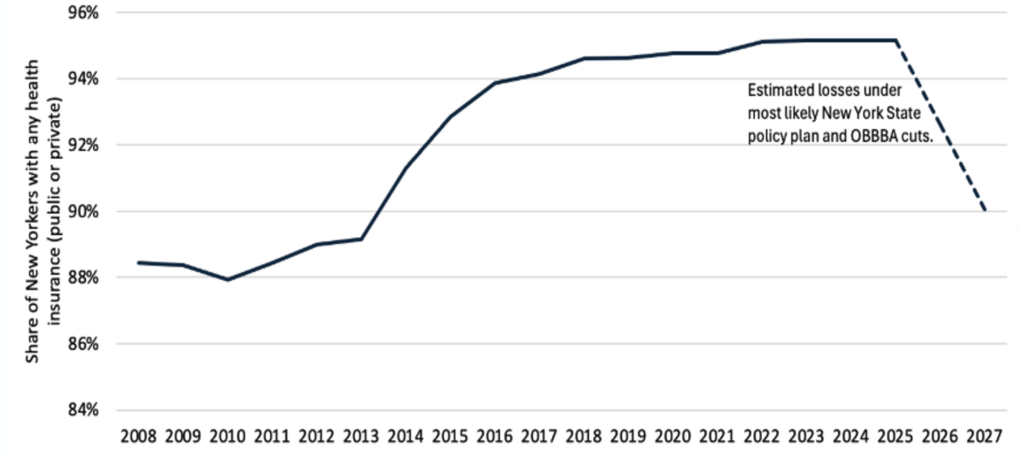
“Unfortunately, neither one-house proposal includes a solution to the coming Essential Plan cliff, which will cause an estimated 470,000 New Yorkers to lose their health coverage this July. Further, neither bill takes strong action to protect New Yorkers threatened with loss of Medicaid coverage due to federal cuts beginning next January. Without a plan, New York will see its rate of uninsurance double, from 5 percent to over 10 percent, erasing all progress the state has made on coverage since the passage of the Affordable Care Act. FPI sees this negligence as catastrophic and urges state lawmakers to enact a plan that will protect healthcare for New Yorkers currently at risk.”
Fig. 1. The Rate of Health Insurance Coverage in New York
Statement on the FY 2027 One-House Budgets
March 10, 2026 |
One-House budgets propose significant revenue raisers but fail to protect health insurance for one million New Yorkers
ALBANY, NY | Following the release of the State Senate and Assembly one-house budgets for fiscal year 2027, Fiscal Policy Institute Acting Director and Chief Economist Dr. Emily Eisner today released the following statement:
“Both the Senate and the Assembly ‘one-house’ budgets represent progressive responses to the executive budget Governor Hochul released in January. Calls for new revenue have been central to budget negotiations this year, and both legislative bodies proposed to increase taxes on wealthy individuals and profitable corporations rather than cut services. FPI applauds these measures, which will enable deeper investments in healthcare, education, universal childcare, and the state workforce. The Assembly lowers tax rates on upper middle-class earners, eroding revenue gains. FPI favors broad-based taxes to support universal public services and thus does not support this tax cut.
“The New York City budget has also been key to State budget negotiations this year. Recently inaugurated Mayor Zohran Mamdani made clear requests for the State to permit the City to raise taxes on millionaire-earners and corporations doing business in New York City. The City’s announcement of a $5.4 billion budget gap at the end of January highlighted the need for new City funding. Both one-house proposals give New York City authority to increase its tax revenue and reverse recent cost-shifting, allocating about $5 billion to the City—enough to close the current gaps and prevent cuts to vital services, but not enough to fully achieve the new Mayor’s affordability mandate.
“Unfortunately, neither one-house proposal includes a solution to the coming Essential Plan cliff, which will cause an estimated 470,000 New Yorkers to lose their health coverage this July. Further, neither bill takes strong action to protect New Yorkers threatened with loss of Medicaid coverage due to federal cuts beginning next January. Without a plan, New York will see its rate of uninsurance double, from 5 percent to over 10 percent, erasing all progress the state has made on coverage since the passage of the Affordable Care Act. FPI sees this negligence as catastrophic and urges state lawmakers to enact a plan that will protect healthcare for New Yorkers currently at risk.”
Fig. 1. The Rate of Health Insurance Coverage in New York