

Proposed Taxes Will Support, Not Hurt, New York’s Economy
March 27, 2026 |
The New York State legislature put forward ambitious, progressive revenue measures in its one-house budget proposals. This has predictably led anti-tax advocates to argue that these measures will damage the state economy. In this brief, we address the misconception that three fiscal policy changes—to the pass-through entity tax credit, the corporate tax rate, and to a tax break on the sale of small business stocks—will damage the state economy. In each case, we show that the proposed tax increases will not erode New York’s economy; we show instead that the most prosperous states in the country tend to have the most progressive tax systems, enabling them to invest in high-quality public goods and services.
Myth 1: Changing the pass-through entity tax will cause millionaires to flee
The pass-through entity tax (PTET) credit allows owners of pass-through income to sidestep the federal cap on state and local tax (SALT) deductions, affording them a substantial federal tax benefit. The Senate proposes lowering New York’s PTET credit from 100 percent to 90 percent. Reducing the PTET credit will keep the federal benefit in place while allowing the state to recoup a portion of its value.
FPI estimates that 91 percent of the value of PTET credit accrues to millionaires (see figure 1). Those earning more than $10 million per year capture fully 61 percent of the total benefit. Some commentators argue that reducing the credit will prompt some of these millionaires to leave the state.
This does not stand up to evidence. First, conditions will remain highly favorable to millionaires residing in New York compared to the recent past. Pass-through income earners in New York faced legitimately higher burdens between 2017, when the federal Tax Cuts and Jobs Act capped SALT deductions, and 2021, when New York enacted its pass-through entity tax. Despite this, millionaires not only remained in New York but became much more numerous. Because a reduced credit would preserve the PTET’s federal tax benefit, New York’s millionaires would still be better off than they were between 2017 and 2021.
Second, two neighboring states already have PTET credits below 100 percent: Connecticut’s is 87.5 percent—more aggressive than the Senate proposal—and Massachusetts’s is 90 percent—par with the Senate proposal. Connecticut and Massachusetts also happen to have the most and second most millionaires per capita in the US. New York is third. Clearly, then, the proposed change to PTET poses no threat to New York’s stock of millionaire tax filers.
Figure 1. PTET credit claimed by each income group
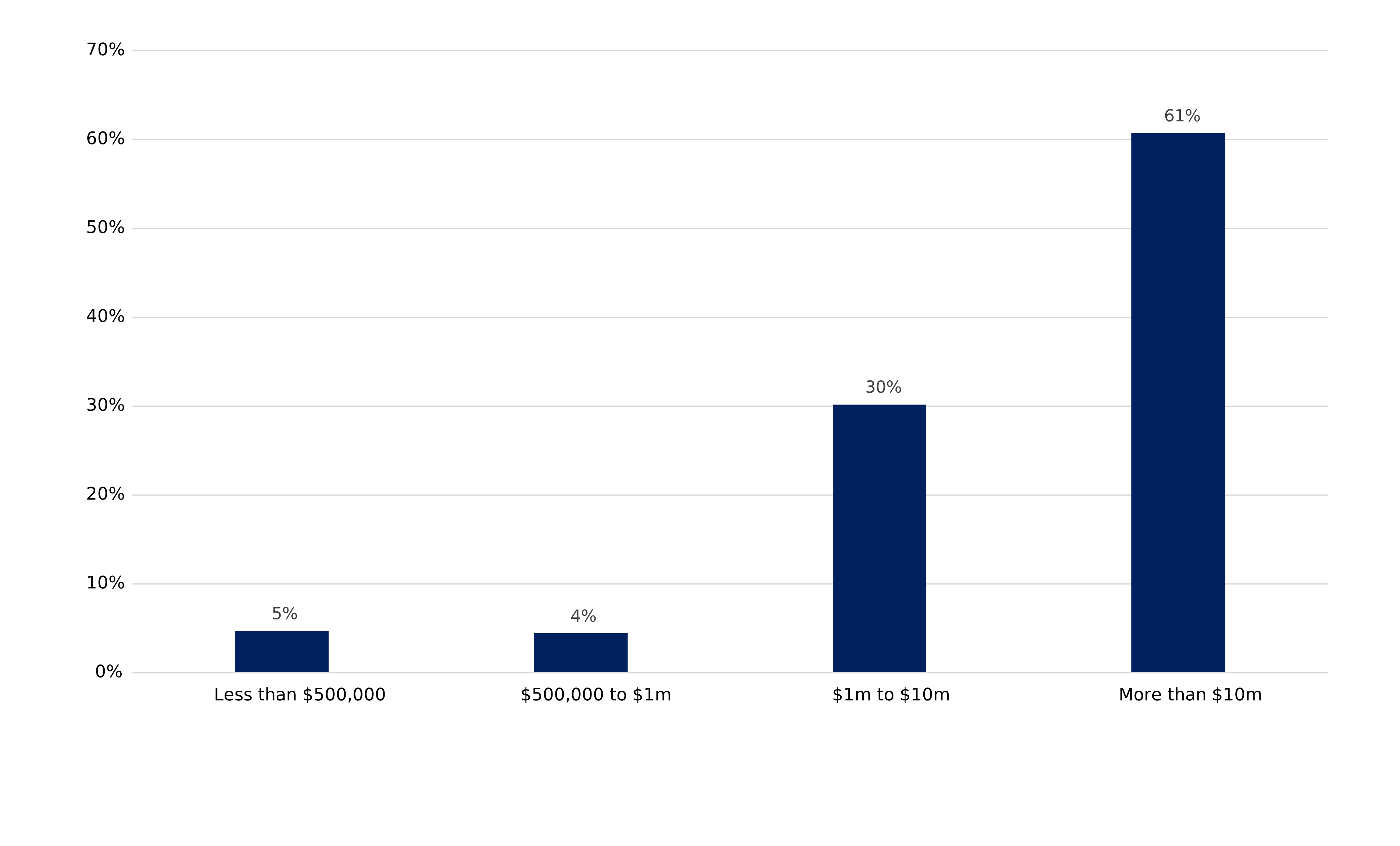
Source: FPI analysis of 2023 personal income tax data from the New York State Department of Taxation and Finance
Table 1. States with the most millionaire tax filings
| State | Total millionaire tax filers |
Millionaires per 1,000 tax filers |
Top PIT rate⁴ | PTET Credit |
|---|---|---|---|---|
| Connecticut | 16,320 | 4.5 | 6.99% | 87.50% |
| Massachusetts | 27,270 | 3.9 | 9% | 90% |
| New York | 69,780 | 3.5 | 10.90% | 100% |
| Florida | 77,670 | 3.5 | 0% | -- |
| New Jersey | 31,390 | 3.4 | 10.75% | 100% |
| California | 128,900 | 3.3 | 13.30% | 100% (87.5% if filed late) |
Source: Internal Revenue Service, Statistics of Income; Tax Foundation.
Myth 2: Large corporations will flee if New York raises the corporate tax rate
The Senate and Assembly have both proposed raising New York’s corporate rate from the current 7.25 percent for corporations with more than $5 million in net income. The Senate would raise this rate to 9.0 percent while the Assembly would increase it to 9.25 percent only for corporations with more than $10 million in income. Some commentators have warned that corporations will flee New York if the proposed hike is enacted. This objection faces two problems. First, it misunderstands how the corporate tax works. Second, it fails to explain real world corporate behavior.
How does the corporate tax work? Corporations pay tax to New York only on the income derived from sales made in the state. If a corporation earns $1 billion in profit and makes 20 percent of its sales in New York, only $200 million is subject to the New York corporate tax. Further, a large corporation that makes sales to New Yorkers is subject to its tax regardless of whether it has a “headquarters,” corporate office, or even a branch store in the state. Even if such a business moved its workers away, that move would only affect its New York tax liability if it began making less money in the state.
Which businesses pay the corporate tax? Most companies in the US are not corporations and therefore not subject to the corporate tax; they are instead partnerships, LLCs, S-corps, or sole proprietorships. Further, most of this tax is paid by very large businesses: about eight hundred corporations representing 0.2 percent of corporate taxpayers account for 75.7 percent of New York corporate tax liability.[1] These large corporations will generally do business across US states; reducing their state tax liability would require them to take self-destructive steps to limit sales made in New York.
Finally, does the location of a corporation’s headquarters influence its behavior? There is no evidence to suggest that it does (see table 2). New York is home to fifty-six S&P 500 companies (the largest public corporations in the US). Only California, with its 8.84 percent corporate tax rate, has more. On a per person basis, New York has the most corporations of any state, followed by California, New Jersey (with its nation-leading 11.5 percent rate) and Massachusetts (8.0 percent).
Table 2. States with the most S&P 500 corporations
| State | # S&P 500 corporations |
Corporations per million residents |
Corporate tax rate |
|---|---|---|---|
| New York | 56 | 2.8 | 7.25% |
| California | 94 | 2.4 | 8.84% |
| New Jersey | 21 | 2.2 | 11.50% |
| Massachusetts | 15 | 2.1 | 8.00% |
| Texas | 54 | 1.7 | 0% |
| Illinois | 20 | 1.6 | 9.50% |
| Minnesota | 9 | 1.5 | 9.80% |
Source: Datasets/s-and-p-500-companies, “constituents.csv,” S&P 500 Companies Data, GitHub, accessed March 27, 2026.
Myth 3: Perhaps smaller businesses will leave
Despite the irrelevance of corporate tax rates to states’ business environments, anti-tax advocates have mounted one final argument: that the State Senate’s proposal to decouple New York from a federal tax break on qualified small business stock (QSBS) will disincentivize the formation of small businesses in New York. The provision allows taxpayers to deduct capital gains earned from the sale of QSBS from their personal income taxes. In fact, the anti-tax crusade against this decoupling seems to have motivated the State Senate to retract their initial proposal—an unfortunate turn of events that will harm New York revenue.
This anti-tax claim is undermined by two key facts. First, California, which has already decoupled from QSBS, enjoys overwhelming dominance in funding for early-stage growth-oriented firms, capturing nearly half of venture capital investment by some measures. The state’s QSBS decoupling has not dented the preponderant attractiveness of its business environment. The evidence once again illustrates that marginal differences in state tax structure are simply not predictive of corporate behavior or the strength of local economies.
Second, New York decoupling from the QSBS tax break leaves the federal tax break intact. The federal tax break is more significant because federal tax rates are higher: tax filers benefiting from the QSBS deduction still avoid a federal capital gains tax rate of 21 percent. Subjecting them to state income taxes, which have lower tax rates (9.65 percent for those earning between $1 million and $5 million) is unlikely to affect behavior. Further, the state’s conformity to the federal provision is not tied to the location of the business. Rather, because the QSBS break is part of the personal income tax, the state law applies according to the stock owner’s primary residence. For example, New York residents currently receive a tax break from the QSBS deduction when they sell stocks of California-based companies. Under the Senate-proposed decoupling, New York resident taxpayers would no longer receive that benefit, regardless of where the businesses in which they buy stock are located.
Conclusion
The corporate and millionaire tax increases proposed by the State legislature will not prompt firms or individuals to leave New York. Rather, evidence consistently shows that the most prosperous states in the US have already adopted these measures. Prosperous states tend to have progressive tax systems, which enable them to invest in high-quality public goods. As such, the legislature’s proposed changes should be adopted
Proposed Taxes Will Support, Not Hurt, New York’s Economy
March 27, 2026 |
The New York State legislature put forward ambitious, progressive revenue measures in its one-house budget proposals. This has predictably led anti-tax advocates to argue that these measures will damage the state economy. In this brief, we address the misconception that three fiscal policy changes—to the pass-through entity tax credit, the corporate tax rate, and to a tax break on the sale of small business stocks—will damage the state economy. In each case, we show that the proposed tax increases will not erode New York’s economy; we show instead that the most prosperous states in the country tend to have the most progressive tax systems, enabling them to invest in high-quality public goods and services.
Myth 1: Changing the pass-through entity tax will cause millionaires to flee
The pass-through entity tax (PTET) credit allows owners of pass-through income to sidestep the federal cap on state and local tax (SALT) deductions, affording them a substantial federal tax benefit. The Senate proposes lowering New York’s PTET credit from 100 percent to 90 percent. Reducing the PTET credit will keep the federal benefit in place while allowing the state to recoup a portion of its value.
FPI estimates that 91 percent of the value of PTET credit accrues to millionaires (see figure 1). Those earning more than $10 million per year capture fully 61 percent of the total benefit. Some commentators argue that reducing the credit will prompt some of these millionaires to leave the state.
This does not stand up to evidence. First, conditions will remain highly favorable to millionaires residing in New York compared to the recent past. Pass-through income earners in New York faced legitimately higher burdens between 2017, when the federal Tax Cuts and Jobs Act capped SALT deductions, and 2021, when New York enacted its pass-through entity tax. Despite this, millionaires not only remained in New York but became much more numerous. Because a reduced credit would preserve the PTET’s federal tax benefit, New York’s millionaires would still be better off than they were between 2017 and 2021.
Second, two neighboring states already have PTET credits below 100 percent: Connecticut’s is 87.5 percent—more aggressive than the Senate proposal—and Massachusetts’s is 90 percent—par with the Senate proposal. Connecticut and Massachusetts also happen to have the most and second most millionaires per capita in the US. New York is third. Clearly, then, the proposed change to PTET poses no threat to New York’s stock of millionaire tax filers.
Figure 1. PTET credit claimed by each income group
Source: FPI analysis of 2023 personal income tax data from the New York State Department of Taxation and Finance
Table 1. States with the most millionaire tax filings
| State | Total millionaire tax filers |
Millionaires per 1,000 tax filers |
Top PIT rate⁴ | PTET Credit |
|---|---|---|---|---|
| Connecticut | 16,320 | 4.5 | 6.99% | 87.50% |
| Massachusetts | 27,270 | 3.9 | 9% | 90% |
| New York | 69,780 | 3.5 | 10.90% | 100% |
| Florida | 77,670 | 3.5 | 0% | -- |
| New Jersey | 31,390 | 3.4 | 10.75% | 100% |
| California | 128,900 | 3.3 | 13.30% | 100% (87.5% if filed late) |
Source: Internal Revenue Service, Statistics of Income; Tax Foundation.
Myth 2: Large corporations will flee if New York raises the corporate tax rate
The Senate and Assembly have both proposed raising New York’s corporate rate from the current 7.25 percent for corporations with more than $5 million in net income. The Senate would raise this rate to 9.0 percent while the Assembly would increase it to 9.25 percent only for corporations with more than $10 million in income. Some commentators have warned that corporations will flee New York if the proposed hike is enacted. This objection faces two problems. First, it misunderstands how the corporate tax works. Second, it fails to explain real world corporate behavior.
How does the corporate tax work? Corporations pay tax to New York only on the income derived from sales made in the state. If a corporation earns $1 billion in profit and makes 20 percent of its sales in New York, only $200 million is subject to the New York corporate tax. Further, a large corporation that makes sales to New Yorkers is subject to its tax regardless of whether it has a “headquarters,” corporate office, or even a branch store in the state. Even if such a business moved its workers away, that move would only affect its New York tax liability if it began making less money in the state.
Which businesses pay the corporate tax? Most companies in the US are not corporations and therefore not subject to the corporate tax; they are instead partnerships, LLCs, S-corps, or sole proprietorships. Further, most of this tax is paid by very large businesses: about eight hundred corporations representing 0.2 percent of corporate taxpayers account for 75.7 percent of New York corporate tax liability.[1] These large corporations will generally do business across US states; reducing their state tax liability would require them to take self-destructive steps to limit sales made in New York.
Finally, does the location of a corporation’s headquarters influence its behavior? There is no evidence to suggest that it does (see table 2). New York is home to fifty-six S&P 500 companies (the largest public corporations in the US). Only California, with its 8.84 percent corporate tax rate, has more. On a per person basis, New York has the most corporations of any state, followed by California, New Jersey (with its nation-leading 11.5 percent rate) and Massachusetts (8.0 percent).
Table 2. States with the most S&P 500 corporations
| State | # S&P 500 corporations |
Corporations per million residents |
Corporate tax rate |
|---|---|---|---|
| New York | 56 | 2.8 | 7.25% |
| California | 94 | 2.4 | 8.84% |
| New Jersey | 21 | 2.2 | 11.50% |
| Massachusetts | 15 | 2.1 | 8.00% |
| Texas | 54 | 1.7 | 0% |
| Illinois | 20 | 1.6 | 9.50% |
| Minnesota | 9 | 1.5 | 9.80% |
Source: Datasets/s-and-p-500-companies, “constituents.csv,” S&P 500 Companies Data, GitHub, accessed March 27, 2026.
Myth 3: Perhaps smaller businesses will leave
Despite the irrelevance of corporate tax rates to states’ business environments, anti-tax advocates have mounted one final argument: that the State Senate’s proposal to decouple New York from a federal tax break on qualified small business stock (QSBS) will disincentivize the formation of small businesses in New York. The provision allows taxpayers to deduct capital gains earned from the sale of QSBS from their personal income taxes. In fact, the anti-tax crusade against this decoupling seems to have motivated the State Senate to retract their initial proposal—an unfortunate turn of events that will harm New York revenue.
This anti-tax claim is undermined by two key facts. First, California, which has already decoupled from QSBS, enjoys overwhelming dominance in funding for early-stage growth-oriented firms, capturing nearly half of venture capital investment by some measures. The state’s QSBS decoupling has not dented the preponderant attractiveness of its business environment. The evidence once again illustrates that marginal differences in state tax structure are simply not predictive of corporate behavior or the strength of local economies.
Second, New York decoupling from the QSBS tax break leaves the federal tax break intact. The federal tax break is more significant because federal tax rates are higher: tax filers benefiting from the QSBS deduction still avoid a federal capital gains tax rate of 21 percent. Subjecting them to state income taxes, which have lower tax rates (9.65 percent for those earning between $1 million and $5 million) is unlikely to affect behavior. Further, the state’s conformity to the federal provision is not tied to the location of the business. Rather, because the QSBS break is part of the personal income tax, the state law applies according to the stock owner’s primary residence. For example, New York residents currently receive a tax break from the QSBS deduction when they sell stocks of California-based companies. Under the Senate-proposed decoupling, New York resident taxpayers would no longer receive that benefit, regardless of where the businesses in which they buy stock are located.
Conclusion
The corporate and millionaire tax increases proposed by the State legislature will not prompt firms or individuals to leave New York. Rather, evidence consistently shows that the most prosperous states in the US have already adopted these measures. Prosperous states tend to have progressive tax systems, which enable them to invest in high-quality public goods. As such, the legislature’s proposed changes should be adopted